
This article is for general informational purposes only and does not constitute legal advice. Laws vary by state, and readers should consult a licensed attorney in their jurisdiction; DUI.org is not a law firm. DUI.org specialists are available for questions about ignition interlock devices and SR-22 insurance requirements.
Understanding your options for release after a DUI arrest can help you move forward with clarity and confidence.
Key Takeaways:
- Learning the terminology that follows a DUI booking can help you understand your case proceedings.
- A bail bond company may offer ways to pay your way out of jail if you can’t afford to pay the full amount.
- Drivers with multiple DUI arrests or whose case meets aggravated grounds may face higher financial penalties.
Knowing the difference between bail, bond, and Release on Own Recognizance (ROR) is one of the first and most important steps in navigating your DUI arrest.
If you’re feeling overwhelmed, you’re not alone. Legal terminology, court expectations, and financial responsibilities confuse many people after a DUI charge. This article breaks things down clearly so you can take the next step with confidence.
Know the Difference Between Bail, Bond, and ROR
It’s natural to feel lost after you’re arrested and charged with impaired driving. “People generally feel scared, confused, nervous, and anxious,” says Mario Garza, owner of 1st Advantage Bail Bonds, in Houston, Texas. DUI.org interviewed Garza’s company, which provides 24/7 bail bond services for people located in Harris County, Texas, and has no commercial relationship with 1st Advantage Bail Bonds.
“My team believes if we educate you about each step you will encounter, it will ease some of the concerns and confusion by helping you anticipate different scenarios in the process,” he says.
Learning the terminology that follows a DUI booking is an important first step. If you’ve never been arrested, the terms bail, bond, and ROR may be foreign to you. Let’s look at what each option means, how they work, and what happens next, so you know what to expect.
What Is Bail?
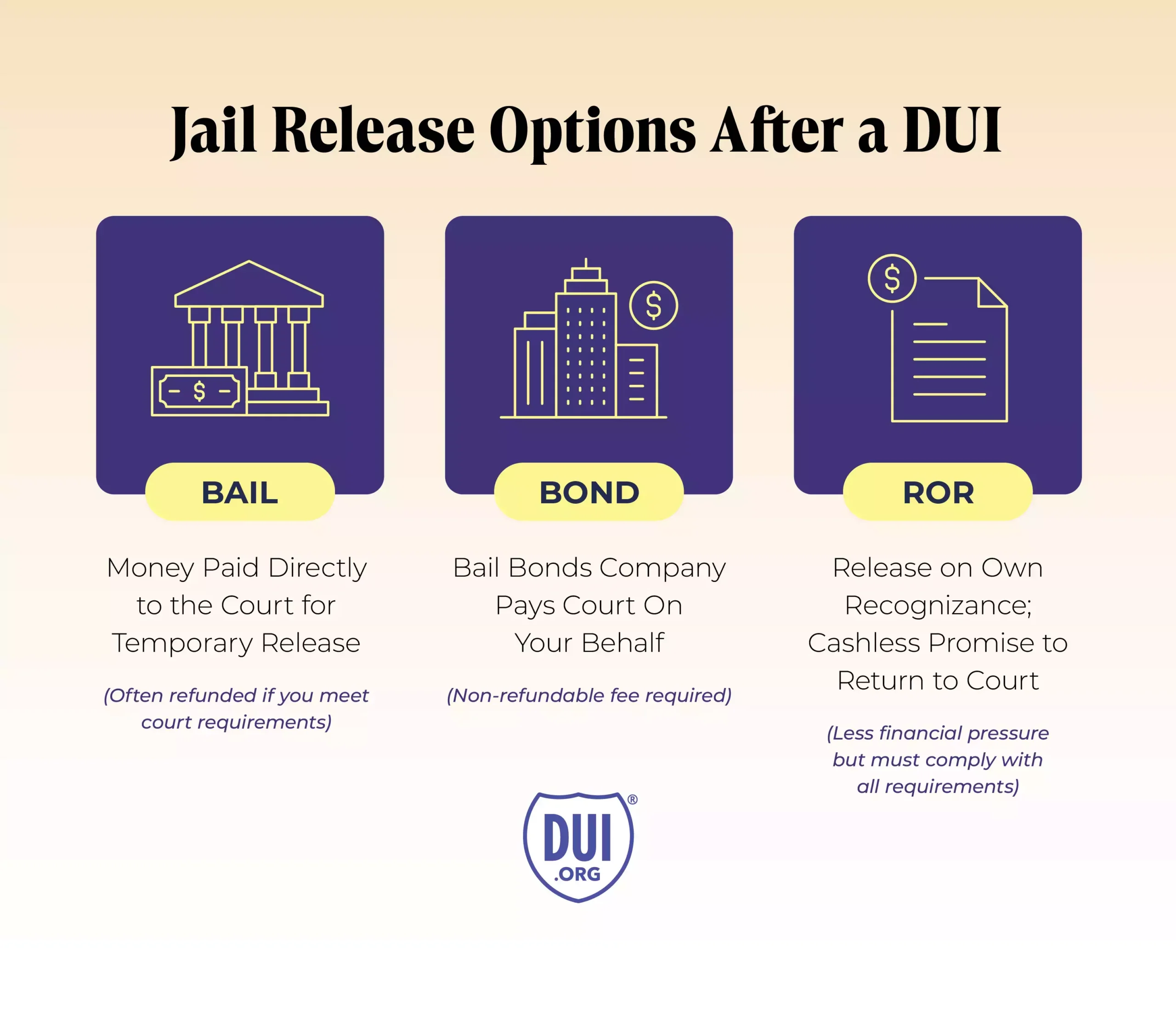
Bail allows you to secure your release from jail by paying a sum of money directly to the court. You provide a financial guarantee that you’ll appear for all your required court appearances. This legal definition of bail offers a more formal explanation.
The court typically sets bail shortly after your arrest. The amount depends on several factors, including:
- The severity of your DUI charge
- Whether the incident involved injury or property damage
- Your prior record
- Your likelihood of appearing in court
If you attend all the required hearings, the court usually returns your bail minus administrative fees. This amount can vary by state. However, if you miss a court date, you could lose that money and face additional penalties.
If you’re unsure how DUI charges progress, this overview of the DUI process explains each stage.
What Is a Bond?
A bond gives you another way to secure your release from jail when you can’t afford to pay your bail in full. Instead of paying the court directly, you work with a bail bond company that covers the amount on your behalf.
You pay the company a non-refundable fee, often a percentage of the bail amount. In some cases, the company may also require collateral such as property or other assets.
While a bond reduces the upfront costs, it adds another layer of responsibility. You must comply with all court requirements. “Once you complete the case, the person who posted the full 100% cash will be refunded the money they posted for your release,” says Garza.
However, if you fail to appear, the bond company may pursue repayment or take legal action against you.
What Is Release on Own Recognizance (ROR)?
ROR, short for Release on Own Recognizance, allows you to be released from jail without paying money. Instead, you sign a written promise to return to court and follow all conditions.
Courts typically grant ROR when they believe you pose a low risk. You may qualify if you:
- Have no prior criminal history
- Maintain steady employment
- Have strong ties to your community
- Face a non-aggravated DUI charge
ROR eligibility is not applied uniformly throughout all states. ROR factors vary significantly by state and are commonly codified by statute or court rule. ROR factors vary substantially by state, and you should consult with a licensed attorney in your state for guidance on the options available in your case.
Although ROR removes the financial pressure, it requires strict compliance. Missing a court date can lead to immediate arrest and stricter release conditions.
How Do You Get Out of Jail?
Different states can have different release requirements depending on the details of your case. For example, some states may require you to stay in jail for a certain amount of time to meet court mandates or until your blood alcohol level drops below a pre-set limit.
Once you meet the requirements associated with your jail time, you may have the opportunity to be released on your own recognizance (or ROR, which we’ll talk more about below), or you may have to post bail. Again, both can depend on the specifics of your case.
If you’re facing a first-time offense, you may not have to post bail. However, if you have multiple DUI arrests or your case may meet aggravated grounds, you may have additional financial expectations.
If your case requires you to post bail, your options are:
- Have a friend or loved one post bail for you
- Hire a bail bondsman to post the bond for you in exchange for a fee, usually 10% of your total bail amount
Once your bail is paid, you can be released. In general, the release process can take anywhere from four to 24 hours.
The National Conference of State Legislatures says not all states allow bail bondsman to operate, so this option may not exist for you in your state. Bail and bond practices vary by state, and you should connect with a licensed lawyer in your jurisdiction to learn about your available options.
Your Responsibilities for Each: Bail, Bond, and ROR
No matter how you’re released from jail after a DUI arrest, your responsibilities begin immediately. Understanding these obligations is the first step in staying compliant and avoiding any further legal issues.
Your Responsibilities and Options with Bail and Bond
When you secure your release from jail through bail or bond, you take on financial and legal obligations. These responsibilities begin immediately after your release.
You must:
- Attend every court hearing on time
- Follow any conditions set by the court
- Avoid further legal trouble
With bail, your main risk is financial loss if you miss a hearing. With a bond, the consequences can extend further. The bond company may recover its losses through legal action or by seizing any collateral you pledge to secure the bond.
“We use indemnity agreements for co-signers to complete and sign in the event someone fails to appear for court and absconds,” says Garza. “The contractual agreements allow for the bonding company to seek legal recourse for our losses in seeking a judgment.”
Your Responsibilities with ROR
ROR comes with fewer upfront costs but requires a high degree of accountability. Courts expect you to follow all conditions without the financial incentive that comes with bail and bond.
Your responsibilities include:
- Appearing at all scheduled hearings
- Following travel or behavior restrictions
- Staying in communication with the court
Failing to meet these expectations can quickly change your situation. Courts may revoke your release, issue a warrant for your arrest, or impose stricter bail conditions.
Even without paying money, you still carry full responsibility for complying with the legal process.
Next Steps After You’re Released from Jail
Once you’ve secured your release, it’s important to understand what comes next and how your actions can impact your case.
Attend Future Court Hearings
Once you’re released, your case continues. Attending every court hearing on time is critical. The court views consistent attendance as a sign of responsibility and cooperation.
Missing a hearing can lead to:
- A warrant for your arrest
- Loss of bail or bond
- Additional charges or penalties
If you want to feel more prepared, review this guide on preparing for court after a DUI arrest.
Hire a Lawyer
A qualified attorney can help you understand your rights and develop a defense strategy to mitigate the consequences you face. DUI laws vary by state, and even the smallest details can influence the outcome of your case.
Install an Ignition Interlock Device
After a DUI, you may need to install an ignition interlock device (IID) to continue driving legally in some states. This device measures your breath alcohol content (BrAC) before allowing your car to start.
The court may require you to install an IID:
- After a first offense in some states
- As part of probation
- To reinstate your license
DUI.org is affiliated with Intoxalock, a provider of ignition interlock devices.
Secure SR-22 Insurance
Many states require filing an SR-22 or FR-44 certificate after a DUI. The SR-22 form proves you carry at least the minimum required vehicle insurance coverage.
Failing to maintain coverage can result in license suspension or additional fines. Planning helps you avoid setbacks and stay compliant.
DUI.org is affiliated with Breathe Easy Insurance Solutions, an SR-22 broker.
Get Back on Track after a DUI
Understanding the difference between bail, bond, and ROR may be part of the beginning of your DUI journey.
To learn more about what comes next, check out our other resources on DUI.org.
DUI.org is owned and operated by Consumer Safety Technology, LLC and is part of the Mindr family of brands which includes Intoxalock, Breathe Easy Insurance Solutions, and Keepr.
Frequently Asked Questions About the Difference Between Bail, Bond, and ROR
What are the most common questions people have after getting arrested for DWI?
The most common question for people dealing with their first drunk driving charge is the amount the bond is likely to be set at, says Mario Garza, owner of 1st Advantage Bail Bonds, located in Houston, Texas. Garza says people often want to know if they should hire an attorney, if jail time will be required, if probation is an option, and what types of fees and/or license suspension will be associated with the DUI/DWI, too.
How do bail bonds work?
A bail bond allows you to pay a percentage of the total bail to a bond company, which posts the full amount on your behalf. The fee is non-refundable, and you may need to provide collateral.
What is the difference between bail and bond?
Bail involves paying the full amount directly to the court. A bond involves paying a fee to a third-party company that covers the bail for you.
What does Release on Own Recognizance (ROR) mean?
ROR allows you to leave jail without paying money. You sign an agreement promising to attend court and follow all conditions set by the judge. There can be strong consequences if you dishonor the agreement.
How much is bail for a DUI?
“In general, DWI or DUI bail bonds are usually low and can be posted for reasonable cost with one co-signer and no collateral required,” says Garza, with 1st Advantage Bail Bonds, in Harris County, Texas. However, bail requirements and eligibility will vary by jurisdiction and the facts surrounding your case. Bail may vary depending on the state, the severity of the offense, and your prior record. Cases involving higher Blood Alcohol Concentration levels or aggravating factors may result in higher bail amounts.
Do you have to post bail for a DUI?
Not always. Some individuals qualify for ROR or other release options. State laws and the court decide whether you have to post bail based on risk factors and the details of your case.
Get support.
What is next? We can help you through the process. Give us a little information and we can support you through the next steps.
All fields are required.