This article is for general informational purposes only and does not constitute legal or medical advice. Laws vary by state, and readers should consult a licensed attorney in their jurisdiction and/or a medical professional; DUI.org is not a law firm or health provider. DUI.org specialists are available for questions about ignition interlock devices and SR-22 insurance requirements.
Uniquely susceptible to DUIs, veterans often struggle to find practical help. Licensed clinical social worker Meghan McHaney shares some of the most effective resources that are available.
Members of the United States military carry an exceptional responsibility. Many who have returned home from combat find themselves dealing with additional complications related to post-traumatic stress disorder (PTSD), which can show up as substance use and addiction.
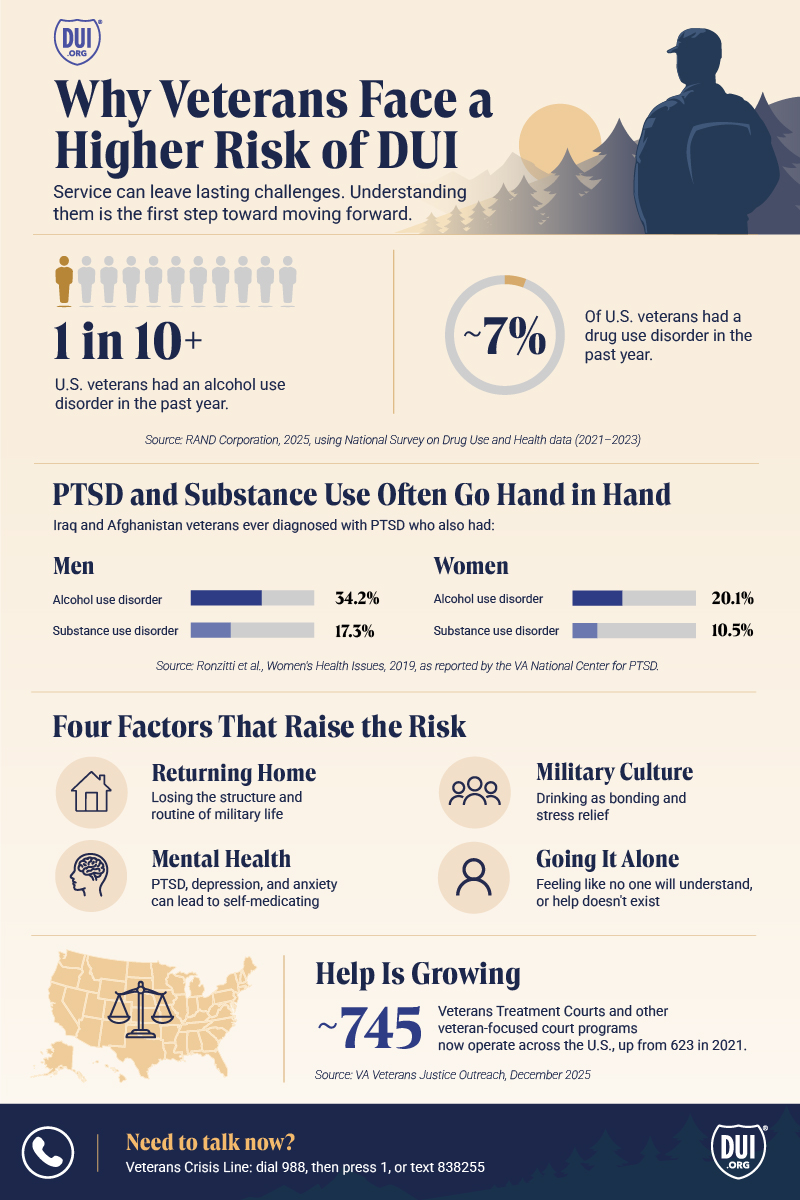
It’s a widespread issue among veterans. According to a 2025 RAND Corporation analysis of federal survey data, more than one in 10 U.S. veterans had an alcohol use disorder in the past year. And among veterans admitted to substance use treatment at non-Veterans Affairs (VA) facilities, about 65% named alcohol as their primary substance, nearly double the rate for non-veterans, according to the Substance Abuse and Mental Health Services Administration (SAMHSA).
Reintegrating with civilian society can be hard enough for members of the military, but the addition of alcohol and/or substance abuse may add a complicated layer. For those who have a DUI, the stressors can be even more enormous and could lead to feelings of shame or embarrassment. But there’s hope. Veterans who need additional DUI support have a variety of options to choose from.
We spoke with Meghan McHaney, a licensed clinical social worker and founder of Trauma Treatment & Training, PLLC in Illinois. McHaney has both professional and personal experience helping veterans readjust to civilian life, including counseling for alcohol and/or drug abuse. McHaney and her practice do not have any affiliation or paid partnership with DUI.org.


What is the long-term impact of a DUI conviction? Just one can trigger significant and lengthy consequences. This article explains how.
Why Are Veterans Vulnerable to DUIs?
The information provided here isn’t medical advice.
Veterans face several challenges that can increase the likelihood of impaired driving.
“If you’re a veteran and you’ve served in conflict and been exposed to trauma, substances often dull all of the physiological activating symptoms,” explains McHaney. “The heart beating fast, muscles tensing, the body being flooded with cortisol and adrenaline... you put alcohol or drugs on top of that and not only do those symptoms go down, but chemical forms of euphoria and joy and social ease come up.”
From a dramatic change to their daily routine, to the lasting impact of their time in service, these are some of the most common complications that veterans often contend with.
Re-acclimation to Civilian Life
The difference between military and civilian life is stark. While on deployment, veterans often have a rigidly structured schedule, various military rules and regulations, and protocols that need to be adhered to. Every moment is spent in service to their country, even with what little downtime they have.
Juxtapose this with what life is like when they return home: no set schedule, no rules and regulations (outside of the regular ones that govern our collective day-to-day). And while there are needs to attend to at home, they’re often not managed under the highly stressful conditions found in combat.
Many veterans struggle with the shift. The loss of routine and less taxing environment can actually create more stress. Additionally, those who don’t have a support system or don’t feel like they can lean on their family can suffer from isolation as they find themselves unable to articulate why they’re struggling with their return home.
Military Culture
Military culture can be very rigid, adhering to a hierarchy that dictates what people are allowed to do, and when. Moving from that kind of structured environment to a more lax approach in civilian life can be a shock to the system for many.
Plus, alcohol use is common in many military environments. Sometimes it’s used socially, considered a part of unit bonding and stress relief. Other times it can be used as a tool to help people cope. Both can normalize heavy consumption. It can be hard for veterans to drop these habits when they return home.
Mental Health Challenges
Depression, PTSD, and anxiety are common among veterans. Many struggle with the complications of combat and have a hard time dealing with the memories they’ve brought home with them.
These conditions increase the likelihood of self-medicating with alcohol. A 2019 study of Iraq and Afghanistan veterans, cited by the VA’s National Center for PTSD, found that among men who had ever been diagnosed with PTSD, 34.2% also had an alcohol use disorder and 17.3% had a substance use disorder. Among women, the figures were 20.1% and 10.5%.
Perceived Lack of Resources
Many men are raised to believe they need to keep a stiff upper lip and not show any emotion. For those in the military, this mindset can be even more pervasive and may create a barrier to getting support.
“Culturally, there’s not always a lot of permission for men, especially men in the military, to have all these feelings and be in touch with their feelings,” McHaney says, noting that the one feeling men are most permitted to have in our country is anger. “That shows up in the military as well.”
Military members are often trained to become problem solvers and face incredible odds on their own. It can be hard to break out of that mindset after deployment ends. Some service members may continue to feel like they must deal with things on their own.
And then there are those who believe nobody will understand, or that people couldn’t comprehend what they’re dealing with. This can stop former military members from seeking out support as needed or believing that the kind of support they need doesn’t exist.

Tips for coping with a drunk driving charge. Follow this article for insights on how to preserve your well-being after a DUI.
How to Know When It’s Time to Reach Out for Support
After military discharge, there may come a point where the effects of adjusting to civilian life start to negatively impact relationships, employment, and even legal obligations.
According to McHaney, signs that it may be time to seek out help include:
- Increased drinking
- Social withdrawal, like pulling away from relationships or isolating
- Driving after drinking
- Irritability or even violence when unable to access substances
- Difficulty managing stress
- General lethargy or extended sleeping cycles
- Trouble meeting court requirements
If this sounds like you or someone you know, there are a variety of resources you can lean on to get some relief.
Veteran-Specific Resources for DUI Support
For veterans who want substance use support through veteran-focused systems, several programs, counseling options, and court programs offer structured support. Plus, each one aligns with the unique experiences of military service.
Veterans Treatment Courts
Veterans Treatment Courts (VTCs) can be found across the United States. As of December 2025, the VA reported that its Veterans Justice Outreach specialists were working in roughly 745 Veterans Treatment Courts and other veteran-focused court programs nationwide, up from 623 in 2021. Researchers describe VTCs as the fastest-growing type of treatment court in the country.
“Veterans courts are a lot like family treatment courts, or mental health courts, and they’re modeled after drug courts,” says McHaney.
Availability still varies a lot by jurisdiction. To find out whether there’s one near you, ask your attorney or contact the Veterans Justice Outreach specialist at your local VA medical center.
Drug courts are effective. Not only are there savings from the prison system, but we see better outcomes for people. We see rebuilt trust with the legal system because you have a team that’s following you and specialized judges.
Meghan McHaney, licensed clinical social worker and founder of Trauma Treatment & Training, PLLC

Searching for a Veterans Treatment Court near you? The National Treatment Court Resource Center has a map you can search by state and county level.
Veteran Diversion Programs
Some jurisdictions offer diversion programs specifically for veterans. These programs allow participants to complete treatment instead of serving jail time using treatment approaches such as:
- Counseling
- Sobriety monitoring
- Community service
For veterans struggling with substance or DUI complications, a diversion program may provide valuable support.
VA Substance Use Treatment
The U.S. Department of Veterans Affairs is uniquely positioned to offer substance support to veterans because of its immersion in military culture. According to the National Institute on Drug Abuse, more than one in 10 veterans seeking support from the VA meet the criteria to be diagnosed with a substance use disorder.
Veterans who seek support from the VA can rely on comprehensive substance use treatment that includes:
- Outpatient counseling, both short-term and intensive
- Self-help groups
- Residential live-in care
- Medically managed substance detox
- Drug substitution therapies
They can also access integrated care for PTSD and alcohol use.
“I think it’s good for us to acknowledge VA is great. It’s created some of the best research for PTSD that we have,” says McHaney. But the VA may not be an option for everyone who’s served.
Not every veteran qualifies for VA services or wants to continue aligning with military culture.
“Some [may not be] honorably discharged,” says McHaney. “I have had a couple veterans tell me, especially a younger one, say, ‘I need to get away from that world. I need to remember who I was before. I want to be in a cute office. I don’t want to see an American flag. I don’t want to see people that I’ve served with.’ It’s a giant trigger for some of them.”
Non-Profit and Community Veteran Rehab Programs
Help and support don’t need to come from a national level. If you look within your community, chances are you’ll find some kind of non-profit or community-based rehab program for veterans. They’re especially helpful to veterans who aren’t eligible for VA care.
You may want to search for inpatient or outpatient rehab programs for veterans. Even community organizations that aren’t specific to veterans might be able to lend support or could point you in the direction of someone who can. These programs often provide trauma-informed care, family counseling, and case management.
Veteran Hotlines and Crisis Lines
For veterans who have mobility issues or live in more rural areas, a veteran hotline or crisis line may be useful for immediate support. For veterans who are suffering a breakdown or need immediate care, a hotline can connect them with a trained mental health professional who can talk them through their crisis and help them find additional resources.
For example, the Veterans Crisis Line offers 24/7 confidential support for veterans and their families. Per the VA, veterans can call 988 and press 1, text 838255, or chat confidentially online. If you’re deaf, hard of hearing, or have hearing loss, use your preferred relay service or dial 711, then 988.
You don’t have to be enrolled at the VA or have health insurance; you just need a phone or internet connection. And if you’re unsure of the resources in your area, they can help you figure out additional support, so you can continue to get the help you need after you hang up.
Veteran-Friendly Technology for DUI Support
Maybe you live in a rural or out-of-the-way locale. Or perhaps you don’t feel comfortable in in-person group settings. Either way, technology can make recovery more accessible for veterans who need flexible or private support options.
While the information here isn’t medical advice, exploring these tools may help you or the veteran in your life stay engaged, organized, and accountable.
Online Support Groups and Counseling
Online support groups and virtual counseling are a quick and easy way for veterans to connect with peers who understand military experiences or find an easy way to maintain a regular counseling appointment.
With an online support group, you can connect with veterans across the nation who can share valuable insights from their own healing experience. Meanwhile, virtual counseling gives you the benefit of privacy but also ease of scheduling to work around your schedule. And if you’re dealing with PTSD, both options allow you to participate from the comfort of your own home.
Telehealth Sessions
Much like virtual counseling sessions, telehealth makes it easier for veterans to attend therapy or substance use treatment. Whether you go through the VA to find a practitioner or use your medical insurance to find someone in network, all you need is a phone.
It’s likely you’ll still need to make an appointment with your practitioner; it’s not the same as calling a hotline and getting instant support. But you’ll still have the flexibility of scheduling at a time that works best for you, and support can be managed from home.
Recovery and Sobriety Apps
Recovery and sobriety apps are fantastic tools for helping you manage your sobriety. Depending on which app you get, they tend to track progress, provide reminders, and offer coping tools to help you stay accountable and make progress during treatment or probation.
Remember that not all apps are created equal, so read reviews to get a sense of what the app really does and how it works. Similarly, different apps have different privacy policies, so read the fine print so you know how your data will be used. But generally, getting started with a recovery or sobriety app is easy. Just search for your app of choice in Google Play or the App Store, and download.
Mood and PTSD Symptom Trackers
Similar to recovery and sobriety apps, mood and PTSD symptom trackers can be helpful for identifying triggers and seeing patterns that can lead to substance use. Some apps act as a journal where you can record what you’re thinking and feeling, while others rely on an icon system to help you easily identify and understand your mood from day to day.
While using a mood or PTSD symptom tracker alone is unlikely to be enough support for you to work through your substance issues, they can be helpful for supplementing other more rigorous treatment protocols for substance use. For example, these apps can work well in conjunction with therapy or in-person/out patient treatment for substance use.

Is it better to plead guilty or no contest to a DUI? This article explains the difference.
Tools That Can Help Veterans with DUI Support
Every veteran’s path is different; some rely on treatment plans, while others lean on technology or peer support. Combining tools until you find what works is okay, too. These solutions are not a substitute for physical or mental health treatment.
Sober Journaling
It may be a low-tech approach to sobriety support, but sometimes the power of the pen can be an exceptionally valuable tool. Plus, it’s cost effective.
Using a notebook and pen of your choice, sober journaling can help you reflect on moments of stress, triggers that drive you to drink or use drugs, and the progress you’re making in treatment. Sometimes, seeing it all in black and white can help you make the connection in your mind and become more aware of your behaviors.
Alcohol Monitoring Bracelets
If tracking your drinking is important, alcohol monitoring bracelets can be a helpful tool in your arsenal. These bracelets work by analyzing the alcohol content of the sweat on your skin to track alcohol levels.
Bracelets can be used voluntarily, or they may be required by certain rehab programs or by court order.
Personal Breathalyzers
Personal breathalyzers are a simple, discreet, and effective way to check your blood alcohol level. They can help hold you accountable, especially if you’re getting treatment for alcohol use.
The Keepr® Breathalyzer is a discreet personal breathalyzer you can carry with you at all times and use to monitor your alcohol intake.
Keepr is owned and operated by Consumer Safety Technology, LLC and is part of the Mindr family of brands which includes Intoxalock, DUI.org, and Breathe Easy Insurance Solutions.
Whether you’re meeting court requirements, supporting recovery, or staying accountable, Keepr gives you the tools to test, track, and share results from anywhere. It’s especially helpful if you have a sobriety accountability team that helps keep you on track.
Ignition Interlock Devices
If you know you have a problem with drinking and driving, or you’re tempted to drive after drinking, installing an ignition interlock device (IID) might be a good option for you. An ignition interlock device prevents a vehicle from starting if it detects alcohol on your breath. You can install an IID voluntarily, or an interlock may be required by the courts if you’ve been convicted of a DUI.
Get Additional DUI Support From DUI.org
After the commitment and dedication you’ve shown to our country, veterans deserve unparalleled support when you return home. This is especially true when you’re struggling with substance use issues. If you’re ready to seek help, McHaney says it’s best to start with a primary care clinic and visit a qualified medical professional.
“I would always start with a doctor because sometimes they’re not going to talk to a therapist, but they might take some medicine to help with their nightmares,” says McHaney.
Whether you’re navigating a DUI or you want to help a veteran who is, DUI.org offers guidance and information. Our resources and articles are always available to lend support and help you stay informed.
Get support.
What is next? We can help you through the process. Give us a little information and we can support you through the next steps.
All fields are required.